


We need stories.
They define our humanity. They’re a way to ensure survival, argue, influence, recreate emotional states, enter worlds or times, create cultural bonds, and encourage empathy.
We’re awash in stories: 30-second brand videos or reels on Instagram, physical or digital books, and narratives in audio or games.
Powerful stories still break through. Art feels more urgent. Our need to relate, enter, connect with, and be moved by stories hasn’t changed.
But even those stories feel threatened.
Maybe it’s the algorithms. Maybe it’s the endless scroll, stories as ephemeral media, the splintering of channels or the sense that we’re losing communal narratives.
But it’s also the sense that AI is changing how stories are created and consumed and that we have little say in the matter.
AI challenges not just the provenance of stories, but whether they continue to make us uniquely human.
AI Is Amplifying a Shift In Stories
Time and access to the tools for creation or distribution were once constraints on media.
As the tools and channels changed, scarcity decreased. You didn’t need a printing press to write a blog and you didn’t need an expensive video camera to post on YouTube.
With AI, there’s almost no natural limit to the quantity of story-carrying outputs that can be produced.
Speed, scale and quantity have almost no upper bound.
But AI also creates a deeper and perhaps more profound shift:
There’s a new creative entity on the planet. Our privileged position as creators no longer holds.
An author is competing with an endless stream of AI-generated books (and they run the risk of being accused of using AI themselves if they add one too many em-dashes in their work).
Filmmakers now compete with video created by machines. They no longer need physical sets or actors, screenwriters or cinematographers. You don’t even need a camera anymore.
That influencer you see on Instagram might not even be real. That clip you see in a Netflix movie may have been created on a PC, no VFX artists, drone shots, actors or camera needed.
AI is in the process of massively extending the already endless shelf of media. For the first time, the majority of content being posted online is generated by machines instead of humans.
Creators are both collaborating with and competing with machines.
The Strange Loop of Media
Three years ago I went deep into the implications of AI and observed that AI was both a media itself and that it looped back to ‘consume’ and replace the media that came before.
This upends the traditional ways in which new media enter the culture.
Television may at first have been inspired mostly by radio plays but it eventually found its own language for storytelling.
But television and radio remained separate. Competitive for attention, maybe, but each with its own ecosystem.
But AI is itself a media AND can produce the television, books, and podcasts that came before.
And so, AI is competitive with today’s creators in two ways:
An author needs to compete with machines at creation (or at least with someone who prompts AI to write a book), AND
‘AI-as-a-media’ competes for time that could be spent reading. Time spent chatting with AI is time I might have spent with other media. More than 1/3 of the conversations with ChatGPT contain some form of fiction.
But chatting with an AI bot isn’t the only form of “AI-as-media”.
There are other consumer-facing forms and, as I’ve proposed before, the things that look like tools are themselves a form of media.
Midjourney or Runway both produce media (video, images, worlds) and are themselves the media through which AI is distributed.
Bigger Challenges in an AI World
For many, AI feels like a valuable act of creation.
Millions have AI companions on character.ai and most of them find value in the entertainment (and dare I say the relationships?) and stories that emerge .
The act of prompting an image into existence can feel almost meditative and magical.
Creators who lacked certain skills can now enter media ecosystems more easily, from Tik Tok to youTube and beyond.
But the new media landscape is also taking place against the backdrop of larger trends:
Consumers are pushing back more broadly on AI, often for very valid reasons.
AI isn’t ‘just a media’. It can do things. We’re now in the ‘agentic’ era, where you don’t just chat with AI, but can assign it tasks, from coding a website to booking airline tickets.
This has caused anxiety (and debate) about AI and its potential impact on jobs, on the safety of our systems, and what tasks will continue to be performed by humans.
The push-back on “AI slop” is both a response to the (likely temporary) gap in the quality of content and a way to express a deeper anxiety about change, loss, and our role in a world that can feel like it’s being overrun by machines (or the people who control the machines).
The Industries of Media
When a new media is introduced, it shifts the industries, creators and channels that came before.
It can change:
How media is financed, with new competition for attention and new opportunities for cross-media revenue (a book becomes a movie, which becomes a TV series or comic)
Who has power and control
How stories are told, with a particular focus on understanding the affordances (or story grammar) of the newer media
The channels for how stories are distributed
The incentives for audience participation
But if AI is both a media and able to generate the media that came before, we’re dealing with change on multiple fronts.
Older media, like film, books or streaming need to adapt to new tools; manage the fact that AI changes who/what can create; and compete with the emergence of new platforms for attention (e.g. ChatGPT).
Their responses include legal, licensing, relenting or partnering. Studios are tapping into new sources of talent and distribution (from influencers to creators on Reddit); creating licensing deals with AI companies; or creating AI-based experiences for fans.
All of it represents a massive change for the story economy.
The Experience of Story
Media is shaped by its hits.
They help to demonstrate the ‘affordances’ of the format.
The Sopranos famously shaped an understanding of the kinds of stories that would work on cable television. Jane Fonda showed how VHS videos could do more than just repackage theatrical releases.
But each media is also its own experience.
A book is usually a solitary experience where the reader has control of when to start or stop. A film is experienced in a dark theatre with other people, with a particular field of vision, sound (and popcorn).
We don’t usually think of the experience of story as something that’s authored. It emerges from the confluence of storytelling, technology, invention, innovation and business.
A filmmaker rarely has much agency over how their film is experienced. They work within the affordances of the media itself.
Christopher Nolan’s Odyssey was partly successful because he exerted some degree of agency over the experience through his choice to film in IMAX. He might not have had any control over how the theatre is designed, but by filming for a specific type of experience he both extended the affordance of his medium and made a strong claim on the preferred experience of his work.
Charles Dickens famously serialized his novels. This didn’t just give him a new distribution channel (and the addition of advertising, something you won’t see in many books), it gave him authorship over the pacing of reveals, plot turns and revelations.
Games, Virtual Worlds and Narrative Experiences
This line between the narrative and a media’s affordances and the experience itself became most clear to me in my work in games and virtual worlds.
I’ve spent 30+ years writing, coding, building products, running a creative agency and otherwise just sort of making stuff.
Almost all of that work was focused on exploring how stories are told in new ways whether via Bluetooth beacons, CD-ROMS (lol), virtual worlds, websites, mobile apps or the blockchain.
The majority of that work was in authoring stories for the affordances of specific media. We’d create a print piece and might control how it was distributed, but print was print. We’d develop a mobile app, but had little control over how people use their phones.
But the more interesting work was when we had some agency in both the storytelling within a media, and how that media was experienced.
Bluetooth beacons, for example, turned physical locations into channels for storytelling. The delivery mechanism was a mobile app, but it was an app that responded to a physical location. How we designed the experience of walking through that location changed the paradigm for how a story was delivered.
Game designers do this all the time. They tell stories within a ‘game’, but also design the experience for the player.
They have a lot more agency in how they design the experience of a story than a novelist might.
Microdramas and the Design Of Experience
At first glance, microdramas are a formulaic response to the vertical format of mobile video.
They’re bad soap operas, designed to make you click to the next episode, with cliff hangers and a ton of close-up reaction shots.
Their ‘film grammar’ is perfectly suited to mobile/vertical viewing, and suits distribution through Tik Tok and Reels as part of the marketing flywheel.
But look past the few minutes of ‘film’ and it’s clear that microdramas have designed an experience of story that has helped propel them to a multi-billion dollar category.
They include new distribution channels (ReelShort and others); they deploy audience incentives through gamification of subscriptions; and they shift how video content is controlled, financed and monetized.
All of this succeeds (regardless of what you think of the stories themselves) because they map perfectly to today’s social media channels; create deep systems for on-boarding and retention; allow the user to ‘view to earn’; and create an experience of story that is in a category of its own.
They’re also perfectly suited to the AI era.
It’s difficult to create a feature film with AI. You lose character consistency. It’s difficult (or expensive) to produce at a high resolution. And AI characters won’t win any Oscars for acting.
But microdramas don’t need high resolution (it’s a phone!), and the plot carries the production, not the cinematography.
Microdramas can be created at scale with AI, but it’s the experience that drives their viewership and revenue.
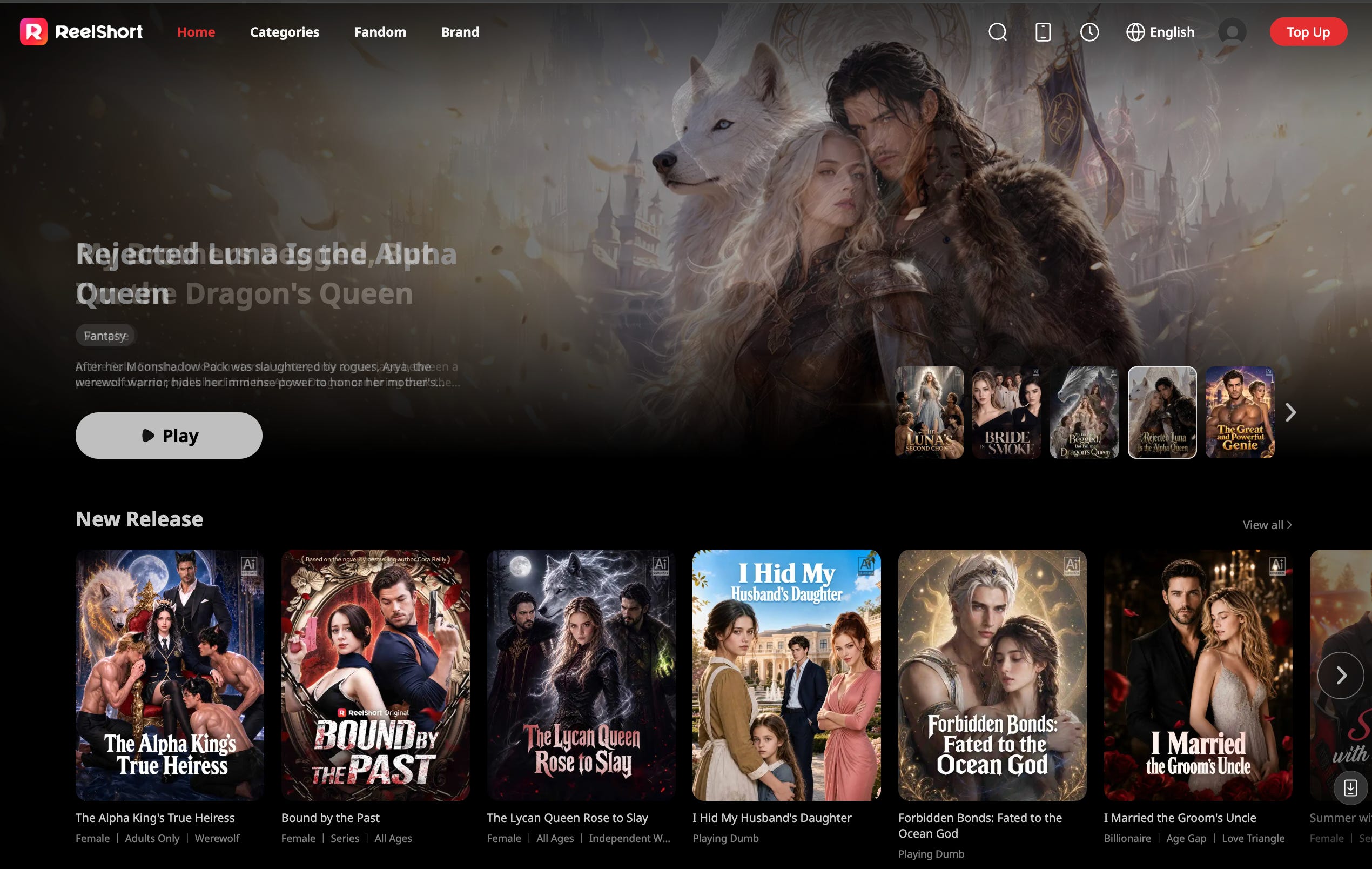
They’re also uniquely suited to adopting “AI-as-media”.
Microdramas can be extended by allowing consumers to chat with characters or ‘prompt’ their own evolution of a story arc. There’s no expectation that this will be art, and adds an engagement layer that wouldn’t suit cinema, say, as cleanly.
Authorship of Experiences
A writer sits down and writes a book. A filmmaker creates a documentary or movie.
Authorship of the experience was usually the job of the platforms, publishers, theatre chains or broadcasters.
An author might ‘do radio’ or post on socials. But that’s mostly marketing.
In the transmedia era, inspired by the thinking of Henry Jenkins (OG), there was a vision of decoupling the ‘story’ from the media. A story world would be created, and then written uniquely for each platform/media.
A comic book has unique affordances compared to a movie, but Jenkins proposed that they should both share the same canon.
Transmedia helped to break the linear distribution model. Authorship included decided which parts of the story to tell in which media and thus introduced some level of agency in how consumers would experience the ‘canon’ in different ways.
But I’d propose that the AI era changes this.
Because even if AI doesn’t write a single word of a story, or generate a single frame of film, it can still be used to widen the ability to generate new experiences of stories.
Instead of competing with AI in generating the media, authorship shifts, and the relationship with audiences expand, because the tools for creating experiences are easier to use, and AI is so far mostly inept at imagining them in the first place.
In other words, authoring the experience of story lets us both respond to AI and take advantage of some of it’s most useful capabilities.
Reframing the challenge in this way, opens up a much wider opportunity space. We can:
Decouple from a focus on one type of output, media, channel or form of distribution
Build larger story-based design objects that are less vulnerable to generative AI
Use the tools of AI in support of authorship rather than as a replacement
Move assembly to the edge and bring stories closer to fans and consumers
Remember that not everything is digital
Move more seamlessly across media channels
A Family’s History
Maybe you’ve used AI to create a presentation based on some work data. Or maybe you’ve used it to create a printed menu of the dinner party you’re throwing on Saturday night.
These are examples of AI can now do things. And those things don’t need to be competitive with creating the source material in the first place.
To illustrate, let me take the story of Helen, who has used SOJEN to capture her family history during the Holocaust:
The story is hers, based on years of research;
She has captured information about family members and locations;
She has then been able to ‘spin up’ experiences of that story, including a printed book for her grandkids or the ability to chat with a grandmother she never met;
She can create an interactive family tree, a mini game that recreates a popular card game from the era, or a jigsaw puzzle if she wanted to.
In the past, an author would be limited to how she could tell these stories. But with AI, she can create the story, choose to author it any media, but also create experiences that would have once been the domain of a studio, a team of programmers, or a platform.
Helen, capturing her family story, can craft an experience not dissimilar to how microdramas have created an entire ecosystem around a soap opera-shaped version of vertical videos.
The Human Power of Imagination
This pushes the power of imagination, of experience design, into the hands of creators.
It results in a new shape to how we’ll experience stories.
Sure, sometimes those stories will be generated by AI. But I’ve come to believe that the real super power that humans have is that they can now have greater agency in how stories are experienced.
By expanding the field in which human imagination can perform, we’ll find new ways to give stories relevance and meaning, even in an era where it’s not only humans who create.