

Every new media brings new affordances. A new ‘storytelling grammar’. Each new technology unlocks a new generation of hits and techniques, talent and fan engagement.
Television unlocked a new grammar for storytelling, and brought it into the very personal space of our living room. Film unlocked a shared and communal space for a particular type of storytelling.
With all of that history it should be easy to spot the ‘affordances’ of AI.
Or if not easy, it should at least follow a similar pattern. Figure out how this technology lets us do something different, explore, push the boundaries, let go of our old ideas. And come up with something aligned to the new technology’s tools and channels.
It has been 3 years since I took my first deep dive into AI as a tool for media creation:
AI, Media and Meaning

We're entering a new era of myth and magic.Thanks for reading. Do think about subscribing:
And for three years I’ve been looking for those ‘affordances’.
What exactly IS it that AI brings that wasn’t possible before? What exactly IS the quality that AI brings to our capacity to create and consume stories?
When will we see the first “AI hit” - the equivalent to the Jane Fonda workout tapes (look it up!) or Sopranos - that era-defining way of telling stories that reshapes everything that follows?
The Challenges of AI
Three years ago, it struck me that AI presents unique challenges.
It’s the first ‘media tool’ that is both its own thing AND consumes the media that comes before.
Television wasn’t a tool to CREATE radio - it was its own thing, with its own affordances. AI, on the other hand, can CREATE radio, and video, and short stories - and is ALSO its ‘own thing’.
Second, AI wouldn’t just be a tool for creators, because it IS a creative agent.
Creators who use AI love to position it as ‘just a tool’. The popular line is that taste is the defining characteristic of AI being ‘done well’ vs AI as generative slop.
YES - there WILL be creators who use AI to create a film that I might actually watch. But it’s EQUALLY true that AI is a direct competitor to ANYONE creating media.
AI can act on its own, it can tap into the algorithmic density of our times to figure out the perfect pattern for a Tik Tok video, podcast script or book that you can buy on Amazon.
So, sure, AI is a tool. But it’s also, at the most banal level, a computer program that can run on an endless loop, generating media at scale, and because of how AI ‘learns as it goes’ it can get better at it.
Finally, I proposed that our relationship with AI would take on a quasi-mythical quality.
Which - I got wrong.
I called it a ”mythos”, and maybe it will still arrive with ASI or something. But what I didn’t anticipate was human ego.
We don’t treat AI as a ‘quasi-God’ with superpowers. Instead, we harbour the illusion that we’re smart enough to ‘conquer’ AI, that our expertise with prompts or harnesses or agentic ‘stacks’ are enough to tame the intelligence.
But this framing also means that we privilege the outputs of AI as something personal, meaningful and profound.
The AI doesn’t care. Our prompts are just blips in a vast ocean of ‘intelligence’.
There’s a myth that we only use 10% of the human brain. It is NOT a myth that most of the capacity of AI sits dormant, waiting, unused partially because of the compute bottleneck, but perhaps even more because we haven’t learned to ask the right questions.
But this personal reward loop, it turns out, may well be a key affordance of AI, at least as it’s currently constructed.
We don’t (usually) anthropomorphize AI. Most of us don’t suffer from AI psychosis.
But we DO privilege the outputs from AI as “our own”.
Decoupling Media + Story
Film makers will create video, and they might entirely use AI or they might use it selectively as part of the ‘pipeline’ (“it’s just a tool”).
People will use AI to generate books and publish them on Amazon.
We’ll create ‘remixes’ of popular characters (whether respecting IP rights or not) and our feeds will continue to fill with “Star Wars in the style of Wes Anderson” images and videos.
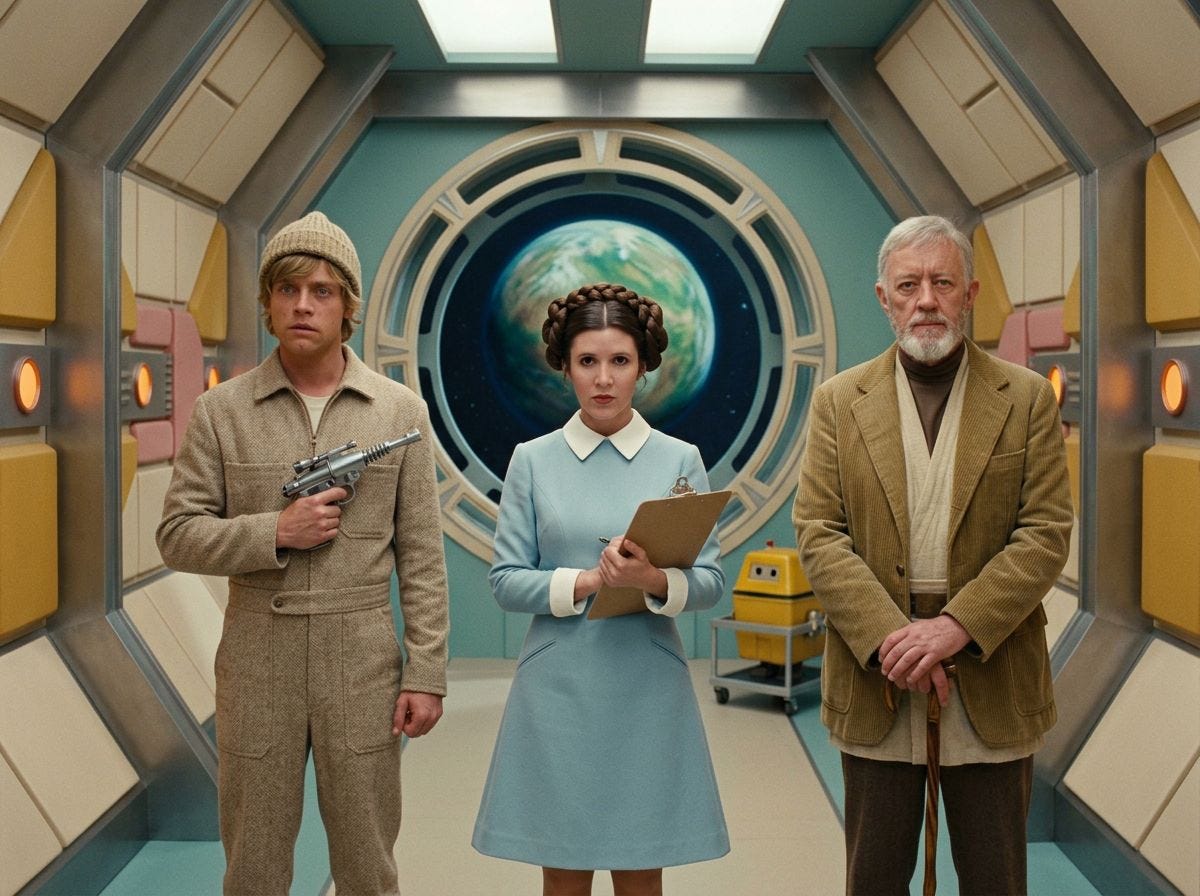
But none of these feel like the ‘affordances’ of AI because they confuse the previous media with what AI represents on its own.
And I’ve seen this over the 3+ years I’ve been building SOJEN:
The easiest thing to ‘chase’ was MEDIA. Being able to spin up a comic book, a podcast script or short story felt truly useful.
I fell into the trap I noted above - the illusion that it was my own ability to ‘harness’ AI that somehow unlocked these capabilities in a new way.
And users ended up expressing a variation of the same thing - that the value in the system was in their personal interfaces with AI, leading to emergent narrative, new ideas, or what one user called “an RPG for storytelling”.
Looked at through this lens, the affordance of AI was NOT its ability to create media that looks like everything that came before - films, scripts, memes, LinkedIn posts or images.
Instead, the affordance of AI is our interface with intelligence (leaving aside how we define ‘intelligence’ for now).
And when I started thinking of it that way, I saw that the ‘affordance’, the ‘grammar’ of this new media actually sits (at least for today) in the scaffolding we build around intelligence, not in the outputs.
Midjourney itself demonstrates the ‘affordance’ of AI but we can easily imagine that it’s the images that get generated that should matter.
Don’t look at the outputs, in other words - look at the places where those outputs are created. Wherever there’s an interface with the intelligence.
Today’s “film-making” platforms ARE THEMSELVES the exploration of the affordances of AI, and NOT the actual video that comes out the other end.
Why Story?
But here’s what’s left unsaid. And it’s the primary reason I’ve started to decouple “media” and “story” when I think about AI.
Social feeds are filled with AI-generated media - some of them reaching millions of views.
Babies doing stand-up comes to mind.
For sure entertaining, otherwise they wouldn’t rack up so many views. Clearly ‘curated’ by some human author managing the prompts used to spit them out.
Now, I won’t argue against them being a form of ‘story’. Story itself has no great privilege - it isn’t reserved for authors (or consumers) with sufficient craft or intelligence.
But AI-generated media leads me back to a central question: what is story for?
In one view, story defines us as human. It was our survival mechanism - a way to communicate knowledge, to make sense of things that didn’t make sense, to create connections within and between tribes.
But if media creation is no longer solely a human domain, can the same be said of story?
I’d propose that the ‘affordances’ of AI are expressed through our interfaces with ‘intelligence’.
But I’d also propose that AI demands of us that we decouple ‘media’ and ‘story’ - both as an exercise in creating new architectures for an evolving technology; and as a necessary act in the reexamination of the role of story in human culture.
What’s your experience with AI-generated media or AI-assisted story? Email me at doug@sojen.io or message me on X.
Let’s start a conversation.