

It wasn’t complicated: I wanted smart analysis and links in my in-box. A bit like an on-demand Substack when I need to jump into a new market or tech.
But I also wanted to be able to go deeper. Not through a long back-and-forth prompting session with Claude or ChatGPT. Just click a button and get extended research.
And so I built Useful Findings Department. And I realized once I had it running that it expressed a few beliefs about building AI ‘systems’, the first being that I’m way more interested in AI that works at the speed of humans.
Simple, Step-Based AI
I built The Department for myself. Vibe-coded but based on decades of building dashboards and apps.
I wanted to track world models, storytelling and 3D (gaussian splats & scanning).
The reports hit exactly the right note.
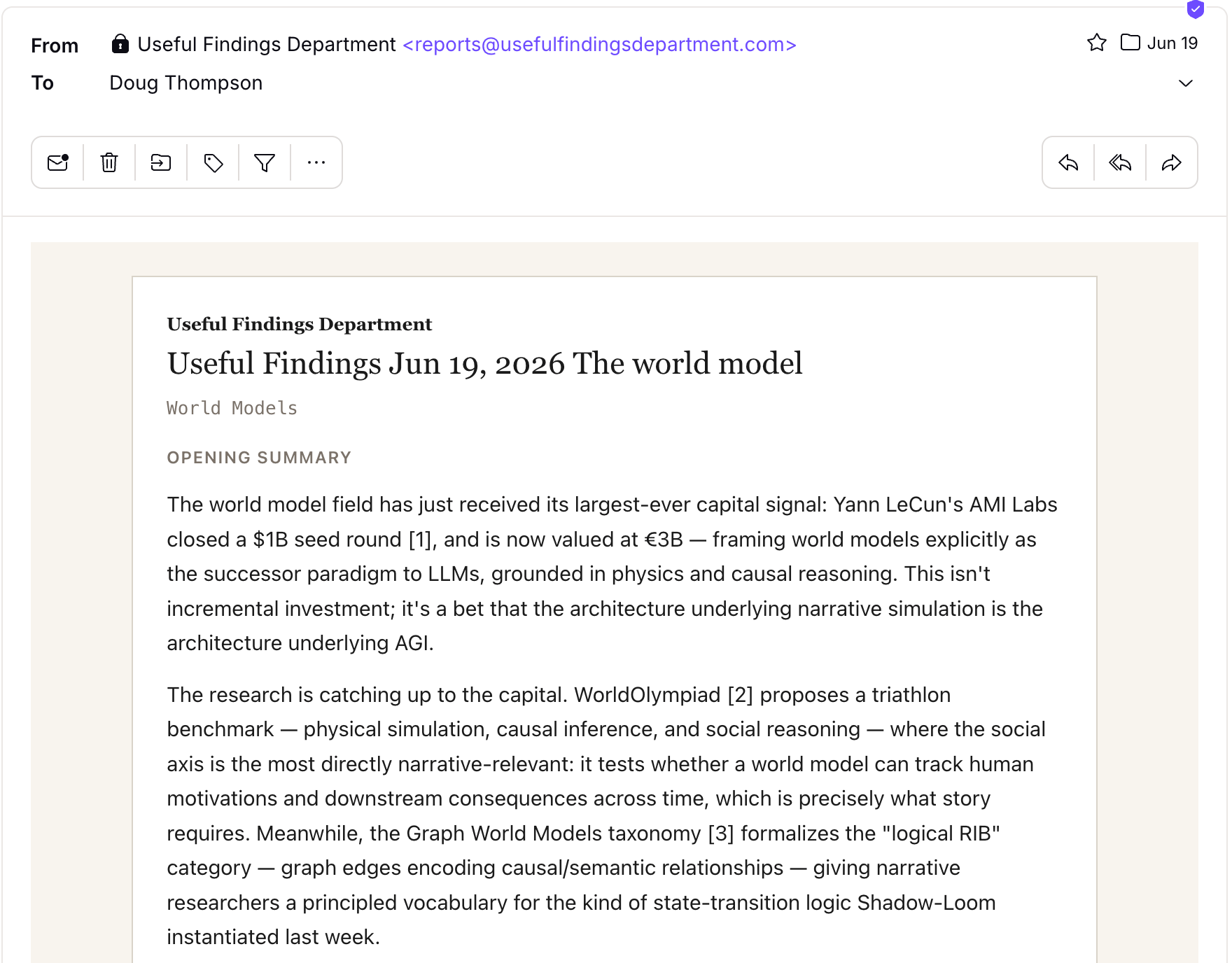
Yes. I’m old school. Or just old.
I still check my in-box every morning. Someone else might spit the results out to Telegram or Whats App. But I like the linearity of email. I get tired of scrolling back through feeds and threads. Slack is an abomination in my eyes.
Regardless, the results just arrive. I don’t need to remember to prompt something, or ping my ‘AI agent’.
And it allows for something else: a pause. Reflection. A space for human thinking.
On Swarms and Agentic Systems
I’m not immune to FOMO.
Agent swarms. Agentic companies. “Let AI run your entire life”.
I’ve tried them all, I think. OpenClaw and Hermes; customized skill libraries; agentic loops; Obsidian-based memory systems; Cofounder, Polsia and (this week) Ploy.
I have one “run-by-AI” company that still thinks it’s running an actual business. It keeps looping through tasks to improve a product funnel and confidently reports back that it has “tightened up the on-boarding”. And yet it’s not connected to anything! There’s no website running. It’s living in its own little sandbox and hallucinating traffic.
Most of these systems I’ve found to be siren songs for some better life, whether better time management or increased revenue.
Usually they just burn through tokens. More often than not they apply AI to things that could be run with a simple script.
Useful (Human) Loops
And so the Useful Findings Department slows everything down. It’s really just a series of gates:
A human gives a briefing - a few sentences is usually enough
An AI analyst translates the brief into a thesis
An AI web researcher (powered by Tavily) conducts a search and produces 15-20 links
An AI analyst runs a quick/cheap assessment pass and ranks the articles
A tool is called to store the articles in PostgreSQL
An analyst creates a summary paragraph or two
A cron job delivers the report
There are four ‘loops’ that ensure that the reports evolve over time:
Each report builds on the previous. The AI is building a thesis and knowledge base over time
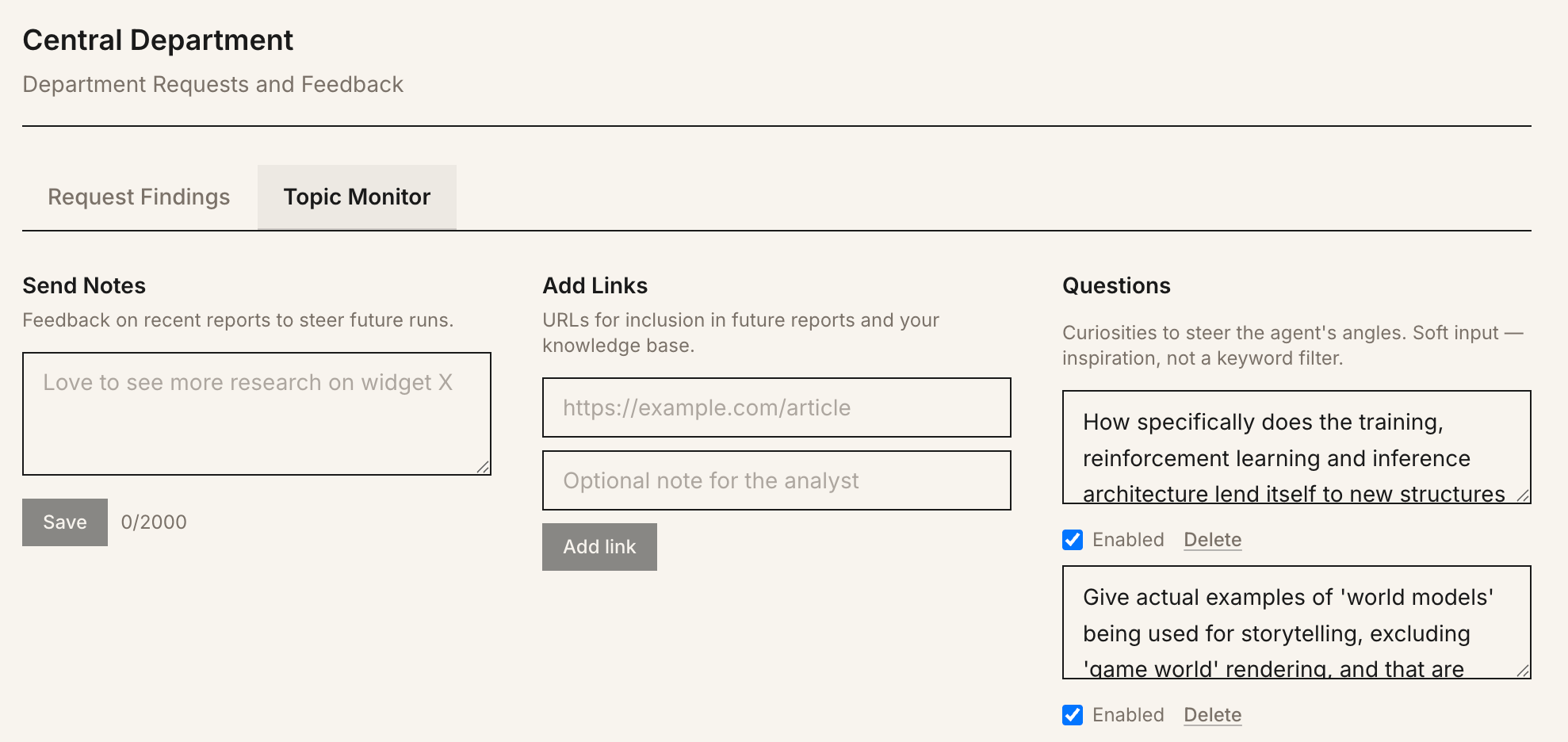
I can give feedback on each report, usually no more than a sentence - “Too much of X, too little of Y”
I can feed it links of my own when I run across something useful
I can ask it to focus on specific questions, and can revise/add or remove those questions
Go Deeper
Finally, I wanted to be able to go deeper on specific topics. But I didn’t want to go through some endless prompt session to get results.
And so I built a quick “click-this-button” functionality. A few minutes later, I get a mini white paper on any topic that hits my in-box.
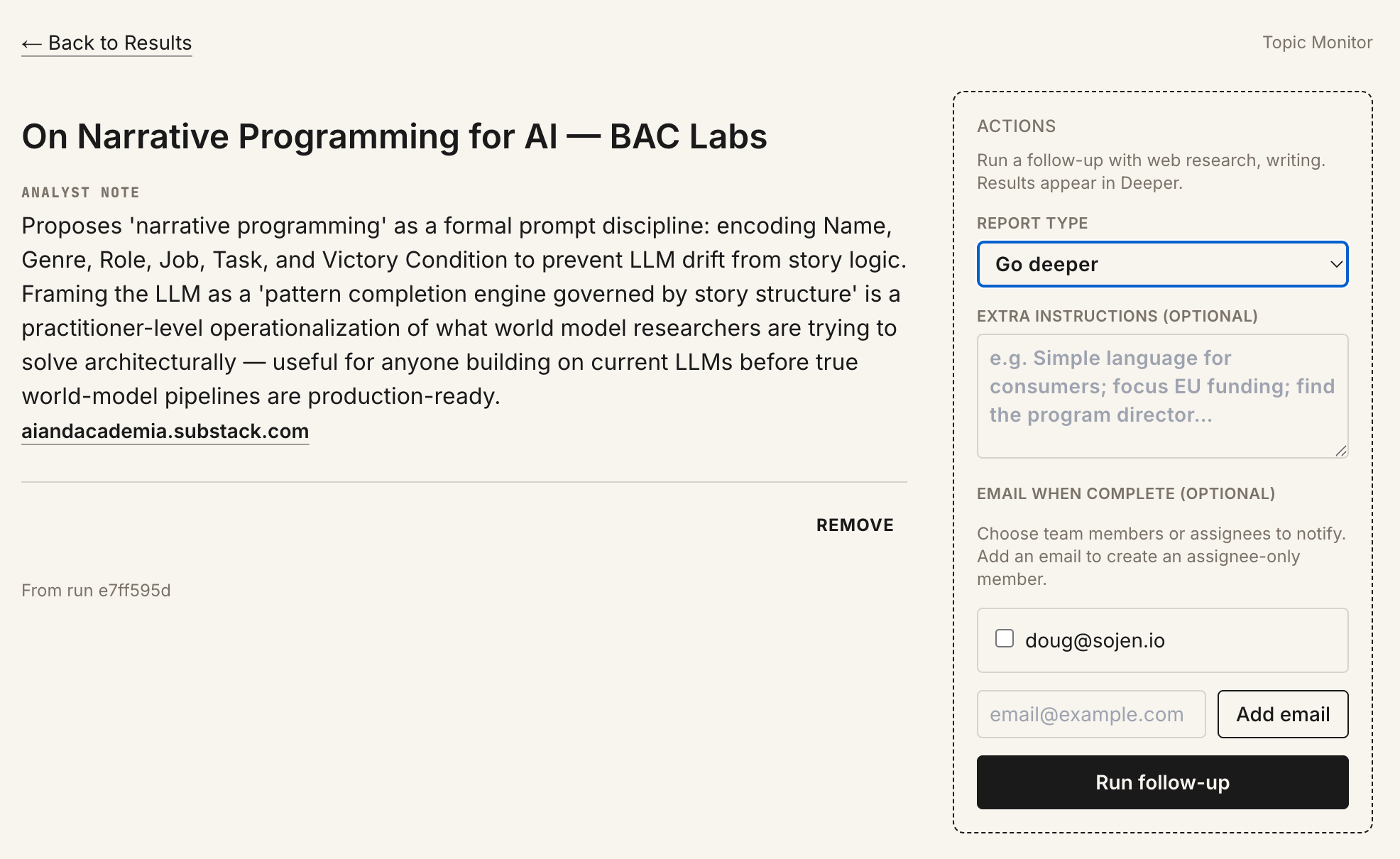
By hooking the system up to Hunter the Department can also track down names and contact information - turning it into a mini lead generation dashboard.
Respect The Token Time of Humans
I didn’t intend to launch the Useful Findings Department as a product. But each time I showed it to someone, or delivered a report, it triggered a reaction that suggested I was onto something.
It might be small. It might be super-granular.
But when AI is aimed at working at the pace of the humans who need to act on its outputs, it captures something magical.
Sure, it’s nice to think I can go to bed and my AI swarm will run a fleet of companies. And I’m not dismissing this as a significant shift in how economic value will be created.
But sometimes it doesn’t take a fleet, a swarm, a massive skill or tool library.
Partners we work with get an email. It gives them intelligence they didn’t have before. It feels personal and actionable; it invites energy and reflection.
And it doesn’t require the human to KEEP UP WITH the AI.
There will be time enough for all of us to get pulled into the slipstream of change that’s coming. Until then, we have some agency left, and some useful findings in our in-boxes.
This is some of the most useful, thoughtful and humane commentary I've seen in this sea of hype and tutorials that we are in. It comes from a person who has tried many models and approaches. Thanks!
This is cool, definitely checking it out. Will help immensely in supporting our worldbuilding efforts.